
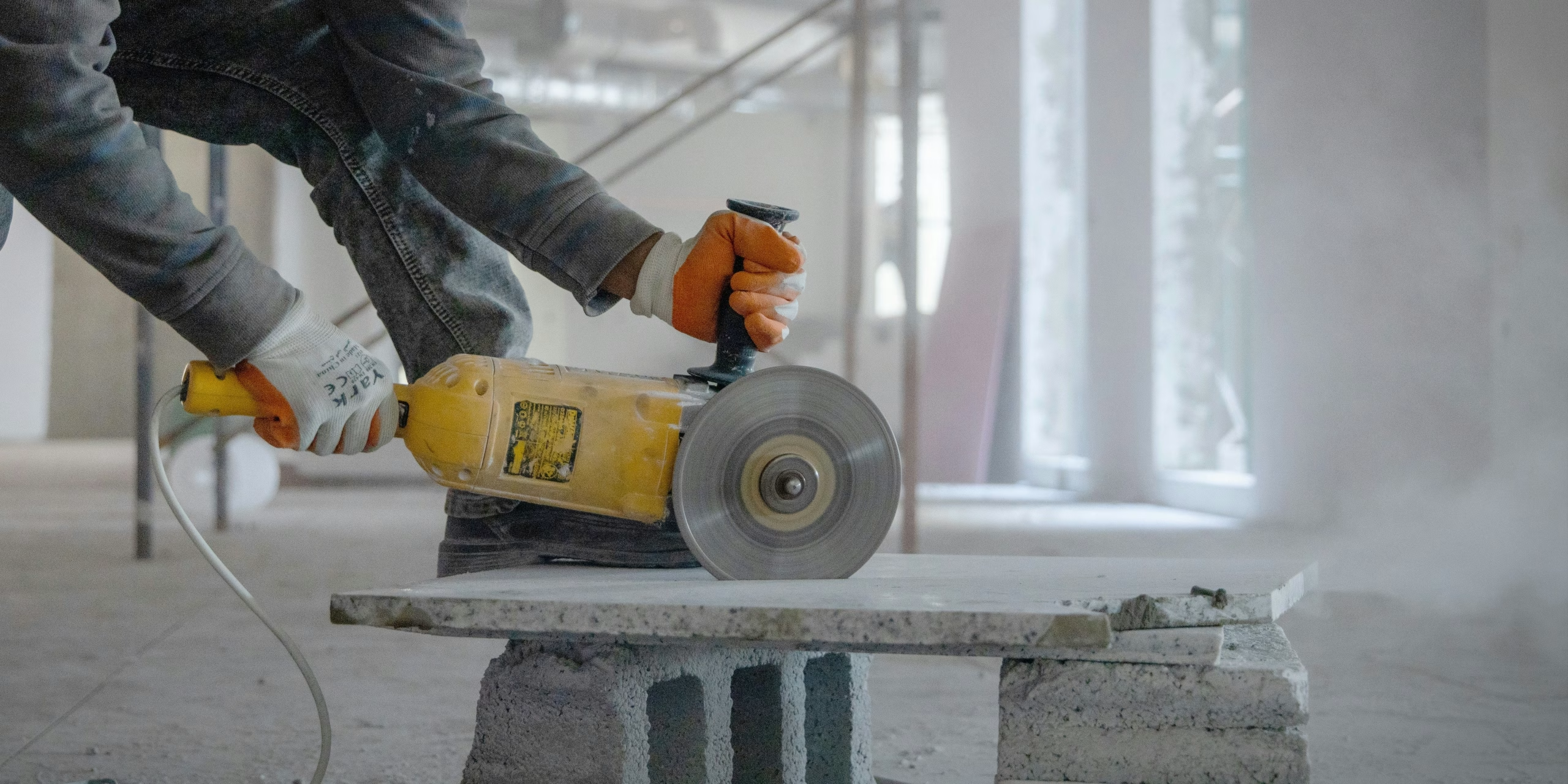
Navigating Australia’s Crystalline Silica Landscape
Why independent testing of manufactured & natural stone matters more than ever...
Recent regulatory changes have altered the requirements for importing and processing manufactured stone in Australia. A national ban on engineered stone, enforcement by the Australian Border Force (ABF), and a tightened Workplace Exposure Standard (WES) require strict compliance across the supply chain for any Crystalline Silica Substance (CSS). Relying on overseas Safety Data Sheets (SDS) or visual inspection is often insufficient. Independent mineralogical testing provides the necessary documentation for compliance and risk management.
Note: This article is acronym heavy, a glossary of acronyms and technical terms is available at the end of this article for your reference.
The Regulatory Reality
Under Australian law, engineered stone benchtops, panels and slabs containing 1% or more crystalline silica (by weight) combined with binders such as resins, water or pigments are prohibited. Furthermore, Safe Work Australia (SWA) and state regulators enforce a Workplace Exposure Standard (WES) of 0.05 mg/m3 (8 hour time weighted average) for respirable crystalline silica. This creates distinct obligations:
- Importers must demonstrate to the ABF that sintered stone, porcelain, and other manufactured alternatives are resin-free or contain less than 1% crystalline silica to clear customs. In some cases, it may be required that other products resembling engineered stone (e.g. natural stone slabs) be demonstrated to be not engineered stone.
- Fabricators, builders, principal contractors & other PCBUs must know the crystalline silica content of all the materials they process. Under national Work Health and Safety (WHS) regulations, processing any CSS containing 1% or more silica requires mandated controls, such as wet cutting, local exhaust ventilation and Respiratory Protective Equipment (RPE), to ensure the WES is not exceeded.
Disclaimer: The information provided above is a general summary of Australian workplace health and safety (WHS) and customs regulations as of August 2026. Stone Initiatives provides independent scientific testing and analysis, but we do not provide legal, regulatory, or compliance advice. Clients are responsible for ensuring their own compliance and should consult Safe Work Australia, the Australian Border Force, their state/territory WHS regulator, or independent legal counsel for specific obligations regarding their products.
Resolving ABF Border Disputes
A new challenge facing the industry is the holding of natural stone slabs (or other exempt products) by the Australian Border Force under the suspicion that it is banned engineered stone. This is an unfortunate consequence becasue, to a non-specialist, natural stone can resemble engineered stone or may have similar descriptions on shipping consignments and subsequently may get flagged.
The ABF requires documentation to confirm that the goods are not engineered stone, this could be (for example) a Material Safety Data Sheet (MSDS), or a test certificate from an accredited laboratory.
When shipments are held at the border, speed, accuracy and reliability of testing is of the utmost importance, which is why having adequate test documentation for every product prior to importation is critical.
As of the publish date of this article (September 2026), the ABF has a highly detailed webpage dedicated to the prohibition engineered stone importation into Australia, including definitions, exempt products, testing requirements and record keeping requirements.
On this webpage they identify two main methods for testing, both of which Stone Initiatives can facilitate.
XRD – X-Ray Diffraction (& expert analysis of results)
(estimated turnaround ~1 to 3 weeks)
If crystalline silica quantification is required, (for example to check if a product falls below the 1% by weight crystalline silica limit), or to determine if a product is defined as a CSS, XRD testing provides a bulk estimate % by weight of crystalline silica content. This type of testing can also be useful to screen for Naturally Occurring Asbestos (NOA) minerals, or to determine if a product is defined as natural stone, porcelain or sintered stone. Depending on the product type, this method may be supplemented by other techniques such as resin content estimate, petrological checks or microscopic examination to determine an accurate definition.
Full Petrographic Examination
(estimated turnaround ~3 to 5 weeks)
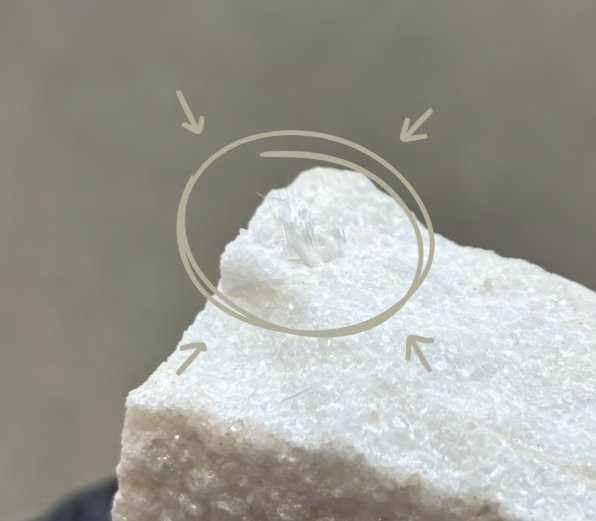
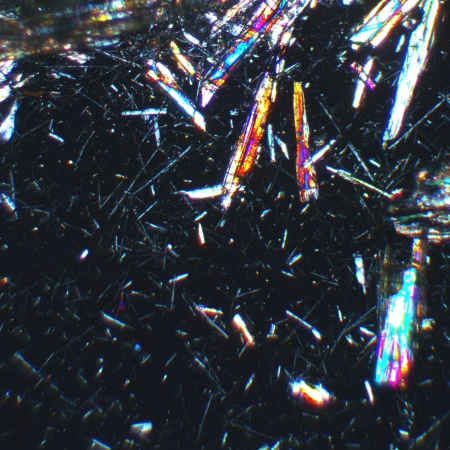
If a comprehensive breakdown of the stone’s binding matrix, trace minerals, textural features and crystal habit is requested, or if the presence of naturally occurring asbestos minerals is also a concern, this method may provide additional detail that an XRD analysis may not be able to provide in isolation.
It is also worth noting that the ABF has specific requirements regarding record keeping. The importer should have sufficient evidence to prove that the sample supplied to the laboratory for testing matches the goods imported. More information regarding these specific requirements is available on the ABF webpage under ‘Before importing, test the product’.
Why Independent Testing is Essential
Overseas sourced Safety Data Sheets (SDS) may not explicitly include crystalline silica content as a percent by weight measurement, may not define what the product is and may not always disclose the presence of synthetic resins. Product marketing names and visual appearance are not reliable indicators of composition. Stone Initiatives can facilitate testing and analysis by expert geologists and mineralogists to determine the composition and definition of manufactured stone products, or any similar products such as natural stone, porcelain, or sintered stone.
Mineralogical analysis of bulk products delivers three main commercial benefits:
- Customs clearance – Fast tracked petrological checks or XRD testing provides the documentary evidence ABF requires to release impounded natural stone or to verify that manufactured products are compliant with the established crystalline silica limits.
- Site risk control – Knowing the estimated crystalline silica proportion (of any product) allows contractors to determine if a product is defined as a CSS and subsequently tailor appropriate control measures, ensuring WHS compliance without overinvesting where it is unnecessary.
- Documented ‘due diligence’ checks – Upfront, independent laboratory data protects procurement teams and principal contractors from purchasing banned or high-risk materials that could expose the business to various liabilities.
Analytical Testing: X-Ray Diffraction (XRD) & Petro-Analyses
For manufactured stone, generally X-Ray Diffraction (XRD) analysis is the preferred and most effective analytical method for determining composition. XRD analysis is performed on a pulverised bulk sample of the manufactured stone to identify and measure its crystalline structures, to provide estimated mineral percentages.
The results provide an estimate of the relative abundance (% by weight) of crystalline silica. This yields a bulk quantitative estimate of the crystalline silica content, delivering the precise data points required by customs officials and occupational health and safety regulators.
(Note: While Stone Initiatives also conducts Petrographic Examination, this complex microscopic analysis is generally reserved for evaluating the structural integrity and trace mineralogy of natural dimension stone, rather than quantifying the composition of manufactured products).
Method | Turnaround | Primary Output | Key Strengths & Limitations |
X-Ray Diffraction (XRD) | 1 to 3 weeks | Bulk quantitative estimate of crystalline silica (%) | Fast screening tool for silica content, or potentially asbestos minerals. Limited sensitivity to trace minerals, and certain mineral types; no textural information. |
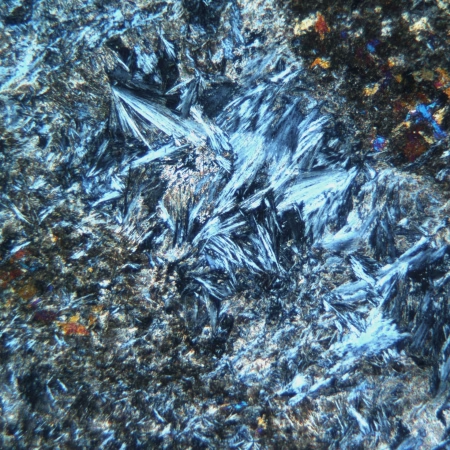
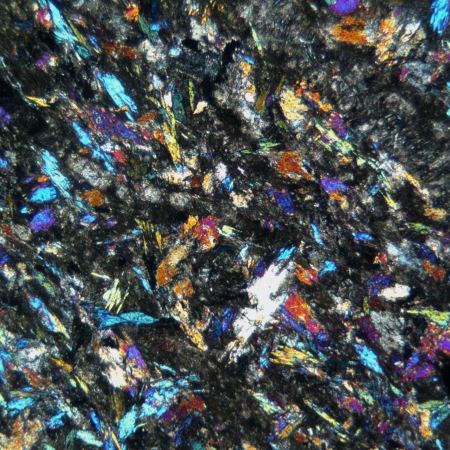
Petrographic Examination (PLM) | 3 to 5 Weeks | Microscopic identification of mineralogy, textures and matrices | Detects micro-textures, structural weaknesses, asbestos minerals, mineral crystal habit (e.g. fibrous) and binder types. Requires specialist thin-section analysis by PLM (Polarising Light Microscopy). |
Note: While not the primary focus of this explainer article, it is worth noting that Naturally Occurring Asbestos minerals (NOAs) are an important feature to screen for in natural stone materials. While methods such as XRD and Petrographic Examination may assist to screen for commonly recognised forms of asbestos in natural stone, an accurate and compliant confirmation of the presence of asbestos requires a separate highly specialised, NATA accredited analysis by a range of other test methods. | |||
Identifying Exempt Materials
When determining if a product is an exempt sintered stone, ceramic, or natural stone, rather than a banned engineered stone, specific key analytical markers are required. While exempt manufactured products typically contain no resin, they can often contain more than 1% crystalline silica. To verify a sintered or ceramic classification, XRD is used to detect key high-temperature minerals, which is then paired with a high-temperature furnace firing to confirm that resinous materials are not in the sample. Furthermore, expert analysis of results by a qualified geologist is critical; by evaluating the mineralogical composition and structural characteristics, a geologist can definitively differentiate genuine natural stone slabs from often visually similar engineered composites, ensuring accurate classification across all product types.
” Because engineered stone is an artificial composite of crushed silica and resin, there is evidence that the nature of the dust it generates during processing differs from natural stone. Accurately distinguishing engineered stone from natural stone, porcelain, sintered or other products requires an analytical approach. By combining visual petrological assessment with quantitative XRD analysis and expert mineralogist interpretation, we can definitively classify the material and determine the precise crystalline silica percentage of any CSS. This level of testing and expert analysis can provide our clients with the data necessary for compliance and confidence.”
Thomas Baggs, Geomaterials Scientist & Co-Director of Stone Initiatives
Practical Implications Across the Supply Chain
- Importers: Testing of sintered stone, natural stone and porcelain products provide the documentation required by the ABF to prove products fall outside the definition of engineered stone (banned material). Testing of hardened manufactured stones with or without resins by XRD provides an estimation of the bulk crystalline silica content as a % by weight to determine compliance with established limits for the definition of engineered stone.
- Fabricators: Test data may assist the development of Material Safety Data Sheets (MSDS), Safe Work Method Statements (SWMS) and controls to meet the 0.05 mg/m³ WES.
- Builders, Architects and Contractors: Test reports reduce the risk of specifying or purchasing banned materials or understanding the risks for allowed, but higher risk products (e.g. other CSS), helping to avoid regulatory or liability issues later in a project.
- Safety managers: Documented crystalline silica and NOA results from bulk products form the basis for respiratory protection controls and strategies for air monitoring in the workplace.
Frequently Asked Questions:
Does the engineered stone ban apply to all silica-containing products?
No. The ban applies to ‘engineered stone’ - artificial products containing 1% or more crystalline silica bound with resins. Sintered stone and porcelain products are exempt provided they do not contain resin. However, it is important to note that any product with greater than 1% by weight crystalline silica may still be defined as a CSS, regardless of the engineered stone ban, and processing these substances may still be subject to strict WHS control requirements.
Can an overseas Safety Data Sheet (SDS) be relied upon for compliance?
Typically, independent verification is required because SDS data from overseas may be incomplete or inconsistent with Australian laboratory findings. However, the ABF may accept testing certificates from outside Australia when the lab is recognised under the MRA scheme (NATA-recognised equivalency internationally) and is accredited by their national body to test engineered stone using the appropriate methods (XRD and petrographic).
What are the typical turnaround times?
XRD analysis generally takes 1 to 3 weeks, though additional time may be required for large batches of multiple samples. Samples may be able to be processed quicker with an expedited fee.
What is defined as an engineered stone?
According to Safe Work Australia, engineered stone is defined as an artificial, hardened product created by combining natural stone materials with other chemical constituents (such as water, resins, or pigments), which contains at least 1% crystalline silica by weight[1].
[1] https://www.safeworkaustralia.gov.au/safety-topic/hazards/silica/engineered-stone-ban
What sample size is required?
Contact Stone Initiatives for current guidance tailored to your material and testing objectives. The sample submitted for testing must be representative of the product and goods intended for import. You can refer to the ABF website for their engineered stone sample testing limits, as samples below a certain size may be permitted for import provided they are for the purpose of testing.
For a standard XRD analysis, at least 1 representative piece of the product/sample minimum 100mm x 100mm x 20mm (or use full thickness for any size other than 20mm)
- Ensure there is adequate sample to be ‘representative’ of the product desired to be tested.
- Generally, each different product and batch that is imported requires a separate test for customs clearance.
- Each sample should be labelled as to be reported.
What is the best test if my natural stone is stuck at the border?
Please contact our laboratory during our office hours to discuss testing requirements, sample requirements and arrange the appropriate crystalline silica analysis to help keep your projects moving.
If your stone is held by customs, we can facilitate expedited X-Ray Diffraction (XRD) testing for a crystalline silica % estimate or a rapid petrological assessment to determine whether a stone is natural or not. This provides an expedited analysis to help satisfy ABF documentation requirements as quickly as possible.
Glossary of Terms
CSS (Crystalline Silica Substance): A specific regulatory term used in updated Australian WHS laws. It generally refers to materials, products, or items containing 1% or more crystalline silica by weight. Important: this classification includes banned engineered stone, and it also includes other ban-exempt products containing more than 1% crystalline silica.
ABF (Australian Border Force): The federal agency responsible for border control. In the context of silica, the ABF enforces import restrictions on prohibited materials, such as the national ban on engineered stone, or the importation of asbestos containing materials, including naturally occurring asbestos minerals.
SWA (Safe Work Australia): The national policy body responsible for developing and evaluating Australian WHS and worker compensation laws, including the national codes of practice for managing silica dust.
WHS (Work Health and Safety): The legal framework, regulations, and codes of practice designed to protect the health, safety, and welfare of everyone in the workplace. In Australia, WHS laws dictate the strict mandatory control measures, exposure limits, and duties required to manage hazardous materials like crystalline silica.
WES (Workplace Exposure Standard): The statutory limit on the airborne concentration of a hazardous chemical to which a worker can be exposed. In Australia, the WES for respirable crystalline silica is strictly capped at 0.05 mg/m³ over an 8 hr time weighted average.
PCBU (Person Conducting a Business or Undertaking): The primary duty holder under Australian WHS law. This is a broad term that includes employers, corporations, partnerships, and sole traders, who hold the legal responsibility for keeping workers safe from hazards like crystalline silica dust.
SWMS (Safe Work Method Statement): A mandatory document for high-risk construction work (which includes work generating RCS) that outlines the hazards of a task and the control measures required to do it safely.
MSDS / SDS (Material Safety Data Sheet / Safety Data Sheet): A document provided by the manufacturer that outlines the ingredients of a product, its health effects, and safe handling procedures. Note: “SDS” is the current standard term under the Globally Harmonized System (GHS), while “MSDS” is the older term but is still commonly used.
RPE (Respiratory Protective Equipment): Face masks and respirators (like P2 or N95 masks) worn by workers to filter out hazardous dust.
XRD (X-Ray Diffraction): A highly accurate laboratory method that can be used to analyse bulk samples. It is the standard for determining the weight percentage of crystalline silica present in a material. It is also used for measuring RCS.
NOA (Naturally Occurring Asbestos): Asbestos minerals found naturally in stones, rock and soil. While different from silica, NOA is often mentioned alongside it because construction projects may frequently manage both where natural stone products are specified.
PLM (Polarised Light Microscopy): A broad term for a few laboratory techniques used to identify minerals based on their optical properties. While primarily the standard for identifying asbestos in bulk materials, similar methods are part of the broader suite of mineral testing for natural stone products. Petrographic analysis / examination involves PLM.
RCS (Respirable Crystalline Silica): The microscopic dust particles created when processing silica-containing materials. Processing may include cutting, grinding, drilling, etc. These particles are small enough to penetrate deep into the lungs and cause silicosis and other health issues.
MRA (Mutual Recognition Arrangement): An international agreement between laboratory accreditation bodies, such as Australia’s National Association of Testing Authorities (NATA). In the context of crystalline silica, an MRA ensures that material testing reports (like an XRD analysis to show a product contains less than 1% crystalline silica) issued by an accredited overseas laboratory are officially recognised and accepted by Australian regulators like the ABF, SWA, and vice versa.
NATA (National Association of Testing Authorities): The recognized national authority that provides independent accreditation for laboratories and testing facilities in Australia. In the context of crystalline silica, NATA accreditation ensures that a laboratory has the technical competence to analyse materials and perform accurate testing.
Article written by: Thomas Baggs & Benjamin Rowe

Thomas Baggs
Co-Director / Laboratory Quality Manager
Head of the Mineralogy Department — Specialising in dimension stone testing, mineralogical examination & laboratory quality systems.
